What
is the meaning of Bo Phloi Sapphire Bearing Basalt? It can be used as classroom samples for
geoscience education. Yoshio Okamoto 28 Sep. - 03 Oct. 2024
Location: Khao Lun Thorm (Bo Phloi, Kanchanaburi)
As the STOP VIII of MUIGC2024 Field Trip Day 2.
REF. https://www.sciencedirect.com/science/article/abs/pii/S1367912019304201
https://www.geo.sc.chula.ac.th/BEST/volume3/Number1/4_BEST_3_1_004_Sutthirat%20et%20al.pdf
Another famous xenolith site: http://yossi-okamoto.net/KVIS/2017/Photo_diary_Part3.html
1) Two typical igneous rocks: Basalt and Peridotite as xenoliths.
2) Xenolith: A direct evidence of shallower mantle materials.
<How do we study inner Earth?>
1) Indirect evidences; Geophysical
study; we can know the physical properties from seismic wave propagation
or gravity measurements etc.
and compare the properties with the rock samples we
can see on the surface.
2) Direct evidences; i) xenolith from mantle <- Here!
ii) rare case: there are some areas where the mantle
layer is discovered; strong crustal movement such as fault or folding,
iii) meteorites: the origin material of our planet
So, the xenoliths are the "letters" from the inner Earth!
My thin-section photos are here;
http://seagull.stars.ne.jp/2024_Sapphire_Basalt/Thin-Section.html
Outcrop video; http://seagull.stars.ne.jp/2024_MUKA/video/IMG_5910.MOV
Outcrop photo;

Fig.1 The outcrop: weathered and fresh alkali basalts are exposed at the road side of a big golf course.

Fig.2 Close up of mantle xenoliths (yellow green colored): lherzolite, a fertile peridotite
About two types of Xenoliths based on Pu Sun et al. 2018
https://yaolingniu.webspace.durham.ac.uk/wp-content/uploads/sites/234/2021/04/2018SunEtAl-Lithos.pdf
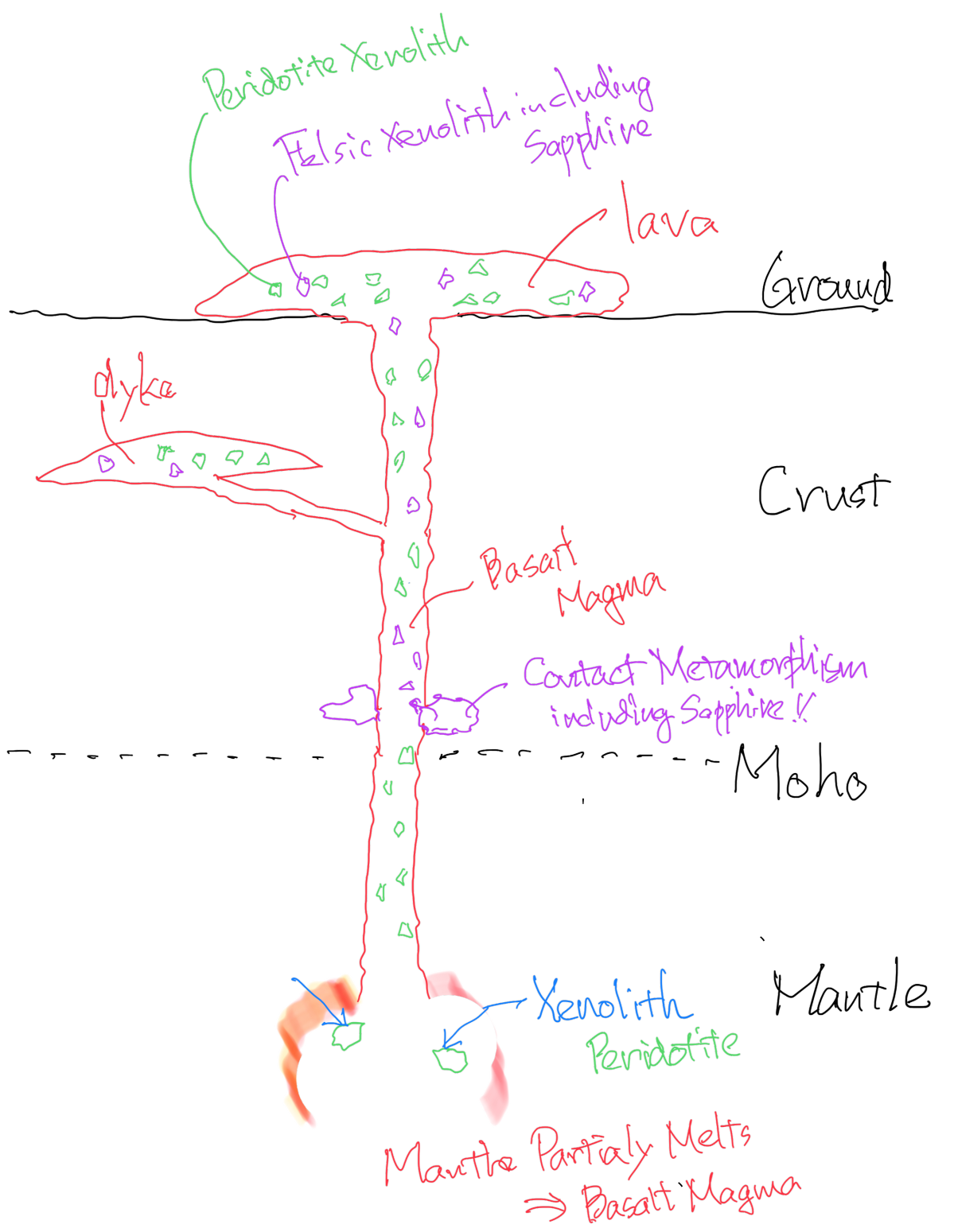
Fig.3 A cartoon of the cause of two type xenoliths (Y.okamoto based on Pu Sun et al. 2018)
Copyright(c) by Y.Okamoto 2024, All rights reserved..